

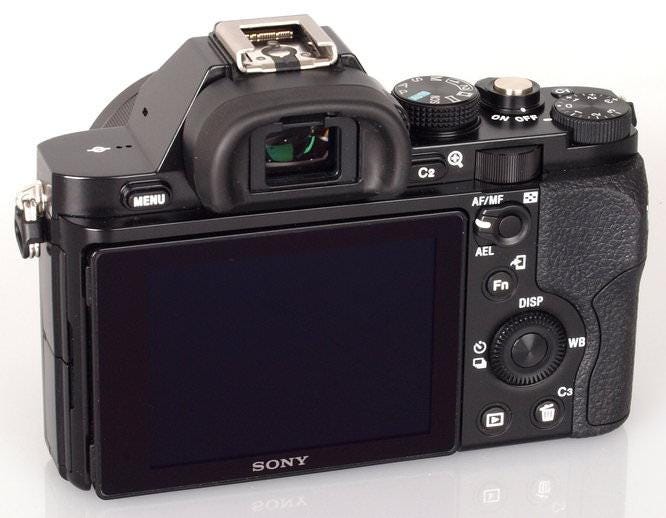
It’s been about three, maybe coming up to four weeks since I picked up my first full-frame camera, the Sony A7 Mark I, the original mirrorless full-frame body. And the fact that I got it in good condition for under £300 still blows my mind. A full-frame camera under £300. What the fuck. Even now, it feels unreal.
I’m still getting used to the system.
And part of that is because I’ve basically been living in Fuji-land for seven years.
(It’s a magical place.)

X-T20, loved it.
X-T3, still love it, never letting it go.
X-T10, because limitation matters. Not because the camera is limited, but because I don’t need endless options when I want to shoot instinctively.
Fuji is where I’m comfortable.
Fuji is what I know.
Fuji is where I learned to see.
Why I Bought the Sony and Why It Has Nothing to Do With Switching Systems.
Let me get this straight from the start. This isn’t a switch.
I’m not leaving Fuji for Sony, and I’m not comparing brands like I’m picking sides.
It’s simple.
I’ve never shot full frame.
I wanted to see the difference.
That’s it.
It could have been any camera. Fuji, Olympus, Pentax. If the price was right, it would have been mine.
Sony won because it was cheap, available, and within reach.
To be honest, I actually started by looking at DSLRs.
Some of them were going for prices close to mirrorless bodies, which made no sense.
And camera prices in general?
Insane.
For work we needed a simple point-and-shoot for events and record-keeping.
If it were down to me, and it is, I would’ve gone for the Fuji X20. My team aren’t photographers. They need something that just shoots and records.
A compact camera made sense.
I assumed £400 to £500.
Reasonable, right?
Nope. £700. £800. £900. for a compact camera.
That’s ridiculous.
So when the A7 popped up under £300, it wasn’t brand loyalty. It was logic.
Full frame for cheap.
Curiosity for cheap.
Sony was the doorway because it happened to be open.
Seven Years of Fuji — Comfort, Muscle Memory, Identity
Fuji’s design language is the closest thing to analogue purity in digital form.
They’re built for touch, intuition, and flow, but not in the superficial retro aesthetic sense.
Fuji ergonomics teach you photography while you’re shooting.
Every dial has a purpose.
Every button has space.
Every control is feelable with your thumb.
Fuji wants you to operate with your hands, not your menus.
Seven years with any system changes the way you shoot.
It shapes your habits, your instinct, your emotional rhythm.
It teaches your body to react before your brain has time to think.
Fuji disappears in your hands, and that’s the whole point.
When I say I’m comfortable with Fuji, I mean:
I know where every dial is without looking.
I know the sound and weight of the shutter.
I know how it reacts in low light.
I know how the colours breathe.
I know what the grain looks like before I take the shot.
I know the camera like a language I learned young.
Or what is more accurate, every single word of the 14 minute version of the Sugarhill Gang’s Rapper’s Delight.
Fuji has become part of my identity as a photographer.
Not because it’s perfect, but because it matches how my mind works.
Tactile. Instinctive. Emotional.
It’s the camera that feels like mine.
Enter the Sony A7 — A Completely Different Philosophy
The A7 feels like a camera designed by engineers, not photographers.
Menu-heavy
Deeply buried options
Programmable but less intuitive
Tighter, flatter buttons
Ergonomics that require deliberate pressure
Early-generation logic that takes time to decode
Even the menu button feels awkward, not because the placement is bad, but because the viewfinder and rear screen slightly block your press. If that button stuck out more, problem solved.
Later versions fixed this because people complained.
Same with C2. Half the time I think I’ve pressed it, and nothing happens.
Fuji buttons protrude.
They click.
They are spaced.
You can find them without hesitation.
Sony buttons feel machine-like. Efficient but distant.
Using both systems makes something very clear.
Fuji optimises for the shooting experience.
Sony optimises for specs and capability.
Fuji lets you express.
Sony makes you control.
Fuji is flow.
Sony is reach.
Fuji is soul.
Sony is potential.
Neither is wrong.
They just feed different parts of how I shoot.
Autofocus, Toggles, and Early Sony Headaches
Setting up back-button focus on Fuji is simple.
On the A7, it felt like trying to read a map upside down.
At first, autofocus made no sense.
Sometimes AF-ON worked
Sometimes it didn’t
Sometimes the camera focused without me touching anything
Sometimes it refused to focus at all
Then came the AF MF and AEL toggle.
Flip it up and you get one behaviour.
Flip it down and you get another.
Suddenly the focus area shifts.
Suddenly AF-ON stops doing what I expect.
It took time to understand the logic.
But the real culprit was something else entirely.
Pre AF.
A setting that makes the camera constantly refocus even when you aren’t touching anything.
So every time I lifted the camera to my eye, it hunted.
Breathing.
Shifting.
Never still.
Eye AF was greyed out with the Viltrox 85mm. Didn’t matter.
Pre AF was the real problem.
Once I turned it off, everything fell into place.
The camera became still.
Responsive.
Predictable.
Autofocus even felt faster because it wasn’t fighting itself.
Vintage Lenses — The Real Reason I Use Them
People romanticise vintage glass. Glow, character, soul.
All true, but not the starting point for me.
The starting point is price.
You can pick up vintage lenses for £10 to £50.
Sometimes more, but mostly affordable.
They work on Sony.
They work on Fuji.
Adapters are cheap.
I’m not building a Sony autofocus system.
I already have modern AF with Fuji.
Vintage lenses give me something else.
Slowing down
Training the eye
Manual precision
Discipline over automation
Rendering that feels imperfect in a good way
A look you cannot replicate in Lightroom
The physical feeling of working for a shot
My current mix:
Nikon AI 100mm
Viltrox 85mm f/2
Pentax 50mm f/1.7
Kiron 28 to 70 on the way
Future Sigma 28 to 70
Eventually a vintage wide 17 to 21mm
This is exploration, not system-building.
One thing I will give Sony credit for is the focus hold button on their lenses.
It feels natural.
Useful.
Something I wish Fuji had.
Creative Reset — Same Lens, New Perspective
Shooting full frame has made familiar focal lengths feel new again.
An 85mm is still an 85mm, on paper.
But through a full-frame viewfinder, it behaves differently.
It looks different.
It feels different.
It is like learning photography again from the beginning.
I’ve been in a creative rut for a while. Not collapsed. Just dulled.
Capable, but not sparked.
Seeing differently helps.
Slowly, something is shifting.
The Sony didn’t fix anything.
It nudged me sideways.
Sometimes that is all you need.
Which Do I Prefer?
Fuji. Straight off.
If I could put a full-frame sensor inside my X-T3, that would be the perfect camera.
I prefer the ergonomics.
The button layout.
The dials.
The feel.
The way Fuji disappears in my hands.
Sony has strengths.
Capability, reach, flexibility.
It extends what I can do.
But it does not replace Fuji.
Fuji is emotion.
Sony is exploration.
Right now, in the state I am in, I do not need a new identity as a photographer.
I just need new ways to see.
Fuji keeps me grounded.
Sony pushes me sideways.
And maybe that is the whole point.
I still need to spend more time with the A7, get more familiar with it. But I’m enjoying the experience.
i do not agree with you on all points but also i am not you so i cannot experience what you are experiencing.
i'm a full frame user since ... long time ago. all my digital cameras (except the toy one) are full-frame. canon user since, again, long time ago. i know my canons inside out with my eyes closed and what else: never use any presets on them. why would i want to shoot b&w on a digital camera? it makes no sense to me at all. shoot raw and if you really want make it b&w after. buy the raw ingredients and cook the meal that i want, not the one that canon sells me. lenses? they are doing exactly what they are saying on the tin: 17mm is 17mm, 300 is 300.
so when i bought the sony, of course i bought a full frame. oh, the canons are dslr's , sony is mirrorless. what's the difference? the weight and the size. ok, the menu is different but i set it up once and that's it. i didn't learn sony's menu because i don't need and it doesn't help me at all if i know it inside out. i know where the buttons are and what they are doing. same with the canons. focusing is on the back for all the cameras. it is simple.
same as you: i am not comparing the cameras, i am using them and i set them up in such a way that they are all working for me and not the other way around.